
Reseller guide
How to calculate a liquidation pallet's landed cost
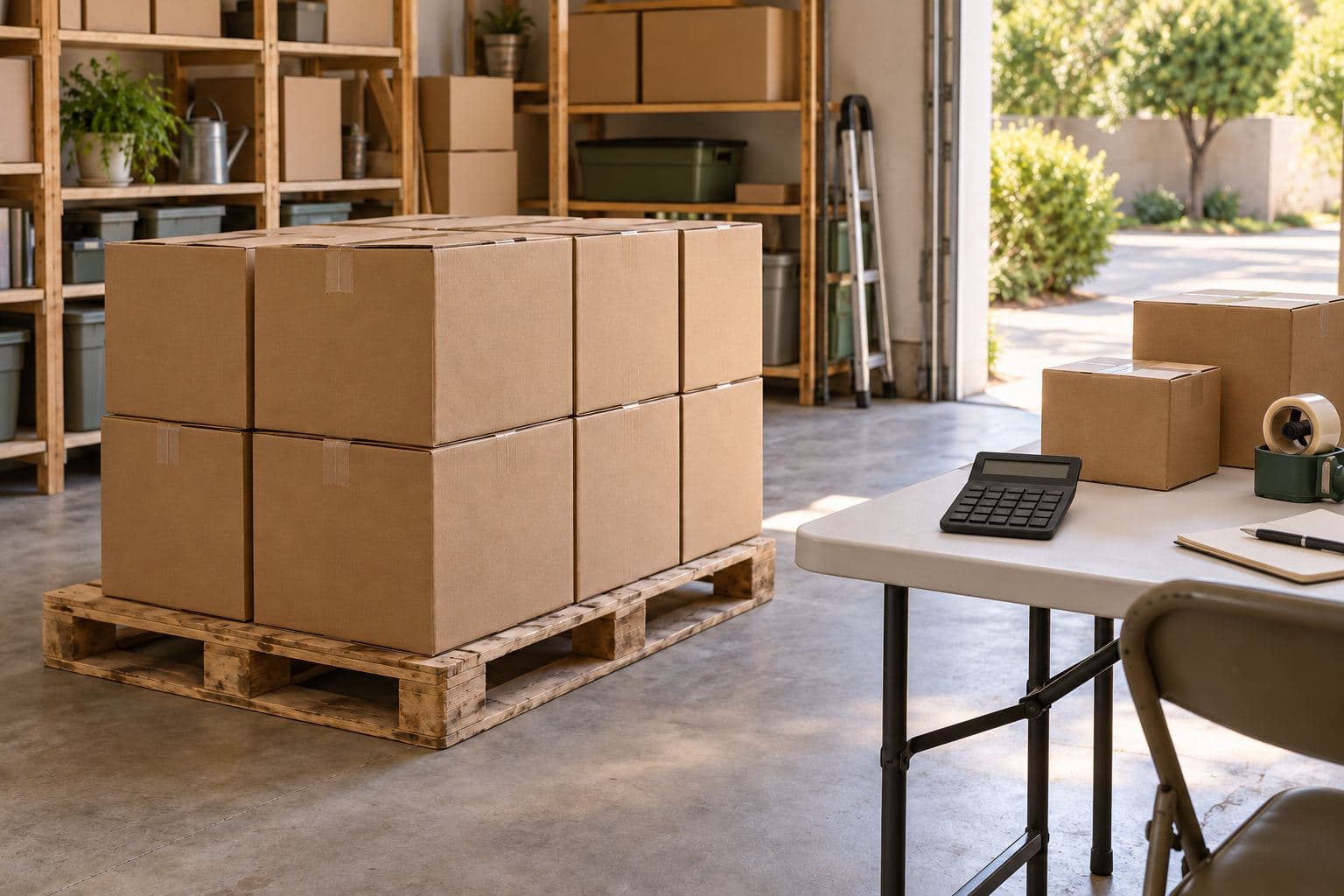
Landed cost is what you pay to buy a pallet and bring it to your destination. Add the price, buyer's premium (an extra purchase charge), other purchase fees, any sales tax, freight (goods transport) or pickup, and other inbound costs. For planning, split it equally across sellable units. Keep charges and counts to revise after checking the goods.
Decide what your total includes
#ConnectBooks' June 24, 2026 guide includes shipping, taxes, handling and tariffs (charges on imported goods). For a domestic pallet, list the charges for getting it to your garage, storage space or other chosen receiving spot. ConnectBooks landed-cost guidance.
For this guide's planning worksheet:
Landed cost = price + buyer's premium and purchase fees + any purchase sales tax + freight or pickup + other included inbound costs.
Record each charge once. A liftgate is a truck platform used to raise or lower goods. If freight already includes that service, don't add it again. When the seller gives only the goods price, keep transport marked as unknown until you get a quote. Unknown isn't zero.
Record repair parts, cleaning, postage to buyers, packing supplies and sales fees separately. They affect your result even outside landed cost. Record general storage and equipment too; their accounting treatment is a separate task. Keep paperwork for purchases, sales and expenses. IRS business recordkeeping.
Check the premium and payment fees
#As of October 2026, B-Stock Supply US charges 10% of the final winning bid as its buyer's premium. Check your listing and terms for its own rate, fee base and other charges. B-Stock Supply buying instructions, Supply fee definition.
Read payment terms before budgeting for goods. Add bank or transfer fees you'll pay, and confirm the listing, invoice and transport quote use the same currency. Check what's included even if one price stands out.
An advertised price is an asking price; a current bid can still change. To compare an auction purchase, use the bid you're considering and add the charges tied to it. Save the math and its assumptions, then use the invoice for the actual figures after buying.
Include sales tax where it applies
#Check the tax rules and accepted forms, then use the tax the seller shows for your purchase. Don't assume you can buy tax-free across the US just because you'll resell. New York currently allows a properly filled-out resale certificate, a form for claiming tax relief on qualifying resale purchases. Supplies you use up have different rules. That's one state's example. New York exemption-certificate guidance.
Follow current state tax guidance for your purchase, business and delivery: check that you qualify, register as needed and choose the right form. New York's ST-120 is marked revised January 2026. Resale certificates cover qualifying purchases, not personal goods. See the glossary for trade words. New York ST-120.
Ask how tax applies to the goods, premium and transport before paying. This guide is not legal, tax or financial advice. An accountant or tax professional can help with stock accounting methods, taxes and reporting. Use the equal split below to plan; it isn't an instruction on how to account for tax. IRS Publication 334.
Price the actual delivery or pickup
#Give the carrier your actual address, access details and equipment needs. Check whether the quote covers home delivery, sites with limited access, a liftgate, an appointment and other services you need. FedEx calls fees for extra freight services "accessorial charges." "Detention" concerns a truck kept beyond its allotted free time. Ask for the carrier's terms and amounts. FedEx freight glossary.
Check that pickup is allowed, then list trip costs such as vehicle rental, fuel, tolls or equipment hire. Explain any overlap with allowances that already include fuel. Check space and equipment with the receiving and storage guide before you commit.
Keep the freight estimate apart from the final bill. If a service has no quote yet, show that unknown charge beside the base total. Two purchases with similar goods prices can have very different totals.
A complete hypothetical calculation
#Example with made-up numbers: Assume 5% sales tax on the $600 goods price plus the $60 premium. The other charges fall outside this fictional tax base. These figures aren't real offers, named-seller fees, local tax rules or expected results.
| Charge | Hypothetical arithmetic | Amount |
|---|---|---|
| Merchandise | Stated purchase price | $600 |
| Buyer's premium | $600 × 10% | $60 |
| Purchase payment fee | Stated fee | $7 |
| Sales tax | ($600 + $60) × 5% | $33 |
| Freight | Includes all agreed delivery services | $180 |
| Other inbound handling | Separate charge, outside the freight quote | $20 |
| Landed cost | $600 + $60 + $7 + $33 + $180 + $20 | $900 |
Assume you receive 50 retail units, each counted as one resale item, and include 45 as sellable after checking them. Record the other five and why you excluded them.
$900 ÷ 45 sellable units = $20 assigned landed cost per sellable unit.
A split across all 50 received units gives $18 each, with $90 assigned to the five excluded units. For the sellable-unit plan, you split all $900 across the 45 included units.
Use the pallet profit calculator for price, premium, freight, sales tax and sellable count. Keep costs it doesn't capture beside its math and in your full worksheet.
Keep the sellable count open until you check the goods
#Before buying, check the manifest, the seller's item list, for the advertised count. Cases (packs of repeated items) or sets sold together may be counted differently from your resale units. Ask the seller how it counts them. Use the manifest guide to compare the list with what arrives.

If only 36 units qualify, the made-up assigned cost becomes $900 ÷ 36 = $25. Fewer units carry the same purchase cost. Keep the first count alongside the revised date, included units and reasons for exclusion.
Track unresolved, missing, damaged, discarded and unsold stock apart. An unsold item may still be usable. Keep pending seller claims on record, and change the cash total only once you have proof of the actual adjustment. That keeps the worksheet tied to your purchase and arrival records. IRS business recordkeeping.
Only test what you can test safely. Don't test swollen or damaged batteries, damaged cords, gas appliances or recalled items. Check the CPSC recalls search and the manufacturer before counting an item as sellable. CPSC is the US Consumer Product Safety Commission. Follow the recall steps and any rules on resale. CPSC resale safety FAQ.
Calculate sale proceeds separately
#For the result after sale costs, see profit after expenses.
Made-up sale example: One unit has the $20 assigned cost above. You receive $40 for a completed sale, with no separate shipping payment. Assume $4 in selling/payment charges, $6 in postage to the buyer, $2 in packaging and $3 in prep costs.
$40 − $4 − $6 − $2 − $3 = $25 after those selling costs.
$25 − $20 assigned landed cost = $5 remaining.
With the same fixed charges, $35 in receipts leaves $20 after selling costs, covering the unit's assigned $20 cost. The charges are fixed only for this math. Actual fees can vary by sale, account and category; see the eBay guide or Whatnot guide for dated channel rules.
The $5 left excludes general overhead (costs of running the business), labor, taxes and changes to your accounts. Covering the purchase cash still leaves you to work out the final accounting result. Unsold stock and your method of accounting for it matter too. IRS Publication 334.
Keep asking prices, completed sale amounts and costs apart. Until an item sells, you have no sale receipt. The item-pricing guide shows how condition and sales of similar items help you choose an asking price. The cost split here isn't a forecast.
Keeping purchase costs beside actual sales
#A notebook or spreadsheet works to bring freight and selling charges together. PalletPro splits the pallet's entered purchase cost plus sales tax evenly across sellable units. Record sale price, fees and shipping when marking an item sold. Keep other buying charges in your full worksheet so the entered pallet amount stays clear; see the app.
Sources
#- How to use landed cost in ConnectStock - ConnectBooks, June 24, 2026 (checked October 1, 2026)
- Business recordkeeping - Internal Revenue Service, date not shown (checked October 1, 2026)
- Buying on Supply US - B-Stock Supply, date not shown (checked October 1, 2026)
- Supply buyer FAQ - B-Stock Supply, date not shown (checked October 1, 2026)
- Exemption certificates for sales tax - New York State Department of Taxation and Finance, updated January 21, 2026 (checked October 1, 2026)
- ST-120 resale certificate - New York State Department of Taxation and Finance, revised January 2026 (checked October 1, 2026)
- Publication 334 - Internal Revenue Service, 2025 tax-year edition (checked October 1, 2026)
- Freight and shipping glossary - FedEx, date not shown (checked October 1, 2026)
- Recalls search - US Consumer Product Safety Commission, current database (checked October 1, 2026)
- Buying and selling products online - US Consumer Product Safety Commission, date not shown (checked October 1, 2026)
Updated
More guides
- How to check a liquidation supplier before buying
Check a liquidation seller's identity, inventory evidence, purchase terms, payment protection, complaint records and delivery obligations before buying.
- How to read liquidation manifests and condition grades
Read liquidation manifests, compare each seller's condition definitions, check unit counts, and keep supplier claims separate from inspection notes.
- Liquidation pallet freight: booking, delivery, and claims
Book pallet freight with the right equipment and access details. Understand LTL, liftgates, delivery notes, damage notice, and freight claim steps.
- Resale certificates and sales tax for liquidation buyers
Understand resale forms, sales tax permits, state rules, and records before buying liquidation goods. Find official guidance for your purchase.