
Reseller guide
Reseller bookkeeping: match sales to payouts
Match each marketplace payout to its sales, fees and refunds, then to your bank. A payout moves money from a seller balance to your payment account; record the customer sale separately so you don't count it twice. Record cash sales even if you spend the cash before depositing it. List unexplained gaps until you can trace them.

Know what each amount means
#Bookkeeping is an orderly record of sales, purchases, expenses and other money movements. Reconciliation means checking that those records agree and explaining gaps. The glossary explains more trade words.
Gross is the amount before deductions; net is the amount after the stated deductions. Check column notes, as reports may count different charges as gross. A seller balance is money in your platform account. Pending funds haven't cleared for payout yet.
A commission is a platform's sale charge. A processing fee pays for handling the buyer's payment; a fee credit reverses some or all of a charge. Link these to the order, the platform's record of the buyer's purchase.
These organizing steps are not legal, tax or financial advice. They build a trail for your tax professional. IRS records guidance allows a suitable record system and requires proof for your entries.
Save the proof behind each entry
#For your first purchase, follow the first-pallet steps.
Keep purchase and separate delivery bills with proof of payment. Save sale details, paid amounts, fees, shipping charges and later refunds. Keep the original reports alongside your sheet so you can see what the platform first reported.
Purchase and expense records need to show who was paid, how much, when and what you bought. You may need several documents; a bank line can lack the goods or business purpose. IRS guidance lists the supporting records.
Use a separate business bank account and check it monthly under IRS Publication 583. Mark your own deposits, borrowed funds and personal withdrawals separately. Your savings deposit isn't a customer sale.
For business trips, keep the date, destination, purpose, miles, total annual miles and expense records. IRS Publication 463 explains the proof needed. Keep files readable, private and backed up; use order references rather than extra buyer details for routine review.
Give sales and transfers separate rows
#An ID is a short reference that connects records. Use your item ID to link a sale to its pallet, and keep platform order IDs, payment references and payout IDs where supplied. A payout can cover several orders; later charges can fall outside an order's first payout.
You can use a sheet like this; it isn't a required accounting format.
| Record | Keep these details | Attach this proof |
|---|---|---|
| Purchase | Source, date, paid cost, tax, transport, item count | Bill and payment record |
| Sale | Item and quantity, channel, order ID, date, item and shipping charges | Order or cash receipt |
| Fee or refund | Type, amount, posted date, original order ID | Platform entry or receipt |
| Payout | Payout ID, amount, transfer date, bank date | Transfer report and deposit |
| Item count change | Returned, donated or discarded quantity and date | Photos and receipt where relevant |
Keep marketplace-collected tax, tax you collect and tax on platform charges in separate fields from item receipts and fees. Take the questions in the sales-tax guide to your state's tax authority or adviser.
Match eBay orders to the bank
#As of October 2026, eBay provides transaction and payout reports, with order, item and payout IDs, plus monthly statements. You can choose report columns to help connect them. A transaction is an entry showing a money event, such as a sale, fee or refund. eBay's report guide explains the fields.
Download transactions and payouts for one period. Match each payout's amount and ID to its bank deposit, then trace the orders, fees, refunds and postage behind it. Keep balances from the prior period visible.
Watch multi-item orders: a report may show an order row followed by item rows. Keep that layout until you've checked where the order totals and item amounts sit. Don't add the whole order amount for each item.
If the bank date is in the next month, mark the transfer in transit at your cutoff. Check pending funds, holds and adjustments before changing a sale to explain a gap. A hold sets funds aside while the platform waits for an event or case to be resolved. See the eBay selling guide for listing and channel rules.
Use Whatnot's order detail with its ledger
#For show and sale rules, see selling on Whatnot.
A ledger lists money movements. Whatnot's web ledger shows net entries affecting your seller balance and exports a CSV, a plain table file for spreadsheets. It omits cancelled orders and detailed order fees. Get those fees from the linked receipt or weekly report. See Whatnot's ledger guide.
The weekly report uses completed orders and UTC dates. UTC is shared world time and may differ from your local date. Here, completion means order funds have cleared. Keep placed and completed dates separate, and check each week in the report's time zone.
Use monthly and annual statements to check opening balance, sales, fees, costs and payouts. Match later refunds and shipping adjustments back to the original order. Save cancelled-order proof elsewhere when it matters to your records.
The current fee page reflects the September 21, 2026 commission change for existing sellers. Check your category, market and account period against the actual charge. Processing is separate. A remembered commission rate can't explain the whole payout.
Record Facebook's actual payment route
#Facebook rules depend on how the buyer paid. A direct cash or payment-app sale has no Facebook payout or Facebook refund process to rely on. Record payment and handover; for a separate payment service, keep its receipt, fees and transfer records. Don't call its deposit a Facebook payout.
For a checkout order, save the order, deductions and transfer details. Follow the help and dates shown on that order, and don't apply a deadline you read elsewhere.
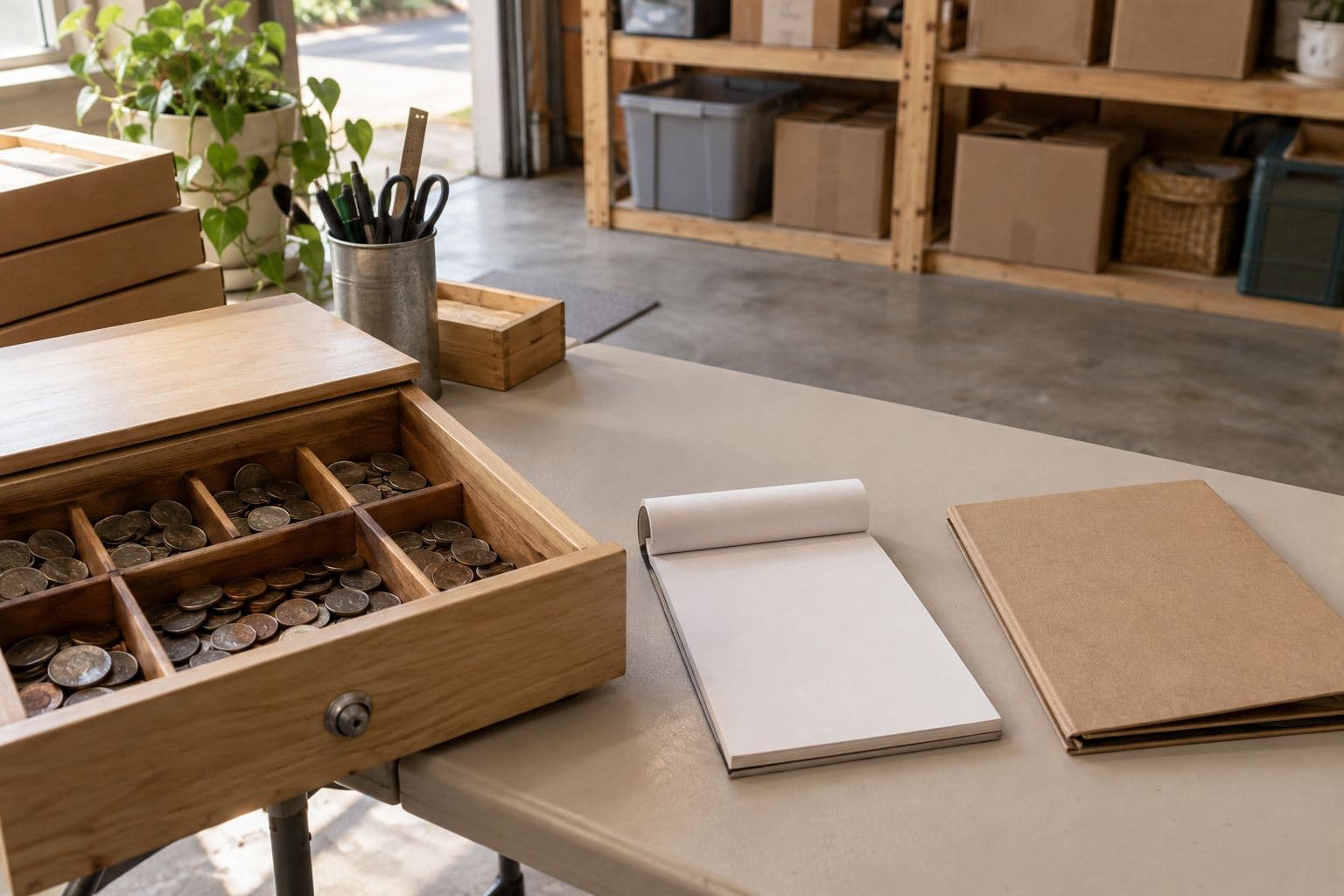
Check cash before making a deposit
#Start with an opening cash count. Record sales, refunds, cash expenses, deposits and money you add or take out. Compare the closing count with the sheet. A deposit moves cash already recorded; it isn't another sale.
Made-up example: you start with $40 for change. Buyers pay $180. You refund $20, buy $15 of packing supplies with cash and deposit $150. Expected cash left is $40 + $180 - $20 - $15 - $150 = $35. Count the drawer. If it contains $30, investigate the $5 gap rather than making up an expense to close it.
Keep the receipt for the supplies and link the refund to its sale. Record the cash sale even if none of that payment reaches the bank. The IRS Form 1099-K guidance also covers business receipts outside payment reports.
Close the month with a difference list
#Made-up example: a platform starts with $50, adds $500 of buyer charges, takes $60 in fees and $40 in refunds, and pays out $400. The closing balance is $50 + $500 - $60 - $40 - $400 = $50. If only $350 of the payouts reached the bank by month-end, list the remaining $50 as a transfer to trace.
Check held or pending funds against the platform's fields. List each gap with its amount, order or payout ID, reason to check and next action. Look for later fee credits, time-zone differences or repeated order totals.
Check goods held for sale too. A refund may bring back one item, no item or a damaged item. Tie it to the sale with the return record guide. Carry unexplained gaps and their notes into the next review.
Check tax forms and keep the records
#Form 1099-K reports gross payments before adjustments such as fees and refunds. Match it to your records without adding its total to sales already entered. Ask the issuer to correct an error under IRS guidance, and keep the correction and messages.
Record retention means how long you keep proof. The IRS gives a usual three-year period but longer rules apply to some omissions, loss claims, payroll and asset records. Unfiled or fraudulent returns have no time limit under that guidance. State and other needs may differ. Set your retention plan with your adviser using the IRS records periods.
Goods still held for sale also need tax treatment suited to your accounting method, the rules for when you count receipts and costs. Publication 334 covers stock and small-business exceptions. Once the books agree, use the profit review to assess the purchase.
Keep sale notes with the right pallet
#Tracing a fee gets harder when the sale has no item or pallet reference. A notebook or spreadsheet works. PalletPro lets you record a sale's price, fees and shipping; paid tiers add expenses linked to pallets and mileage entered by hand. Keep the platform reports and bank checks alongside those item records. See the app
Sources
#- Business records to keep - IRS (checked October 1, 2026)
- Publication 583 - IRS, December 2024 edition (checked October 1, 2026)
- Publication 463 - IRS, 2025 edition (checked October 1, 2026)
- Publication 334 - IRS, 2025 edition (checked October 1, 2026)
- Using the Payments tab in Seller Hub - eBay (checked October 1, 2026)
- Reconciling your eBay sales transactions - eBay (checked October 1, 2026)
- Ledger / Transactions Page in Seller Hub - Whatnot, May 13, 2026 (checked October 1, 2026)
- Seller Weekly Orders Report - Whatnot, May 6, 2026 (checked October 1, 2026)
- Seller Statements - Whatnot, August 20, 2026 (checked October 1, 2026)
- Whatnot seller fees - Whatnot, October 1, 2026 (checked October 1, 2026)
- What to do with Form 1099-K - IRS (checked October 1, 2026)
- How long should I keep records? - IRS (checked October 1, 2026)
Updated
More guides
- Selling liquidation items locally: listing and pickup
Prepare liquidation items for local listings, show their condition, manage holds and no-shows, arrange safer pickups, and record payment after handover.
- Selling liquidation items on eBay: condition and costs
List liquidation returns on eBay using verified condition, comparable sales, current fees and shipping costs, with a clear plan for packing and returns.
- Selling liquidation items on Whatnot: prep and fees
Prepare liquidation items for Whatnot, choose supported conditions, calculate current seller fees, set auction starts, and pack orders within the deadline.
- Handle reseller returns and refunds step by step
Handle buyer returns on eBay, Whatnot and local sales. Check case deadlines, inspect returned goods, and record refunds and stock changes.